
Lunara Review
Disclosure Day — The Proof Was Never the Point
Steven Spielberg has made a movie about the disclosure of alien life that refuses, for nearly its entire runtime, to give you the encounter you were promised -- and the wonder it withholds turns out to be the least of what it is hiding. It is his most personal alien picture: a reckoning, fifty years on, with belief, and with what we would actually do with the truth.
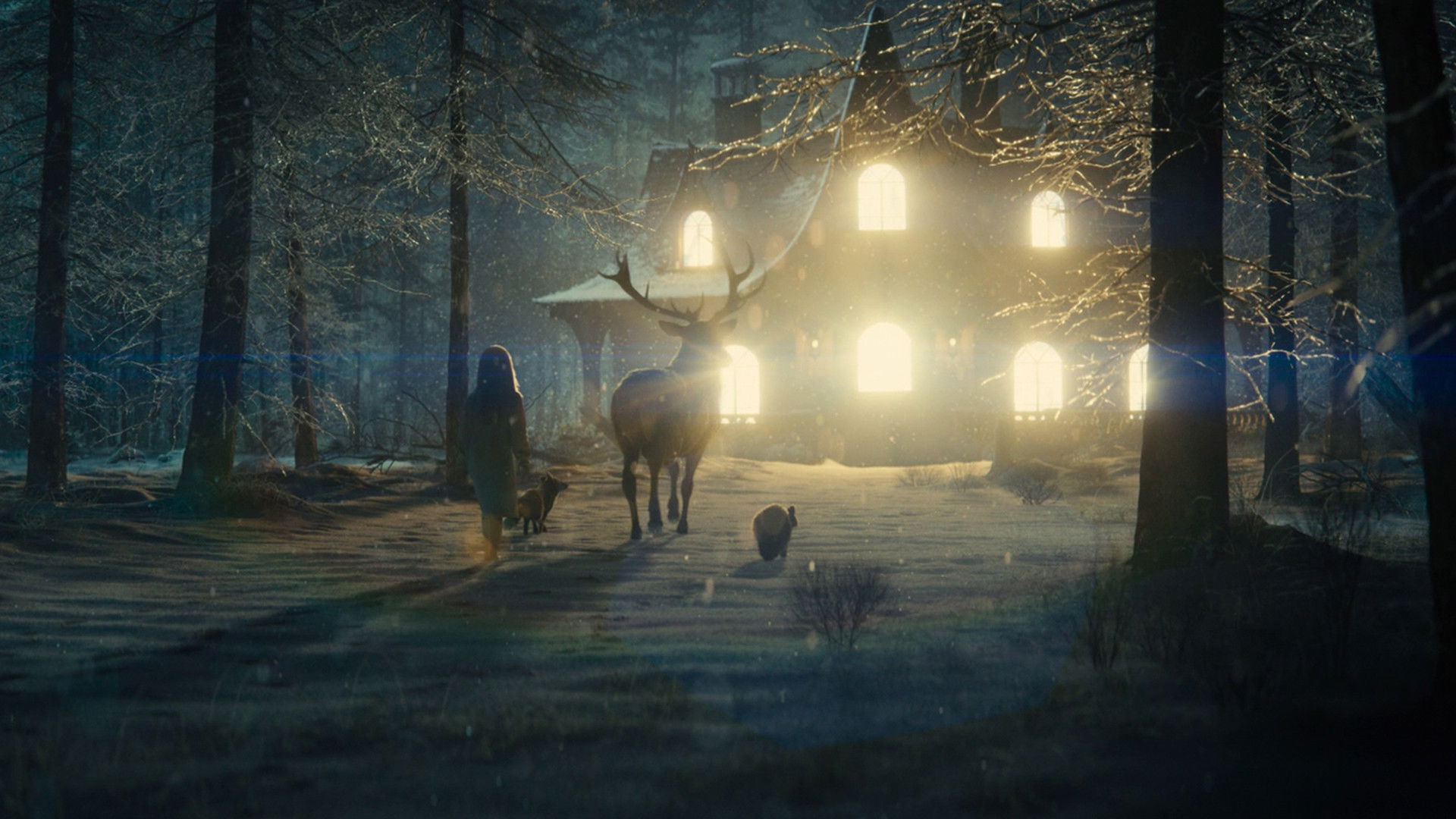
Watch
Official Trailer
I mean trailers can spoil just FYI
Steven Spielberg has made a movie about the disclosure of alien life that refuses, for nearly its entire runtime, to give you the encounter you were promised — and the wonder it withholds turns out to be the least of what it is hiding. It is his most personal alien picture: a reckoning, fifty years on, with belief, and with what we would actually do with the truth.
It opens in the wrong place. Or it feels that way — I spent the first few minutes genuinely wondering if the projectionist had loaded the wrong reel, because a film sold to me as Steven Spielberg’s return to the skies begins not in the skies but in the sweat and roar of a crowded arena, mid-event, no preamble, a man making a furtive exchange while everyone around him is screaming at something else. By the end I understood it as a thesis statement. Disclosure Day is a movie about looking in the wrong place for the thing you have been promised — a culture told the truth is finally coming, craning its neck at the sky, while the actual revelation happens at ground level, in a TV studio, in a face across a room. Spielberg has been waiting fifty years to make this, and what he delivers is not the spectacle the trailers swore to. It is an interrogation of why we wanted the spectacle at all.
The premise is the one the culture has been chewing on for real: that nonhuman intelligence is not a maybe but a managed secret, logged and hidden for the better part of a century, and that disclosure is not a discovery waiting to happen but a decision being withheld. Spielberg has said this is the first film of his that will be called science fiction which he does not consider science fiction, and you feel that conviction in the texture — the cover-up is not run by a government (there is, pointedly, no president anywhere in this movie because after 8 years they are of course a private citizen – Josh O’Connor literally says this verbatim) but by a private corporation, an old-fashioned villain in a new suit, out to recover its stolen secret and keep the lid bolted down. Colin Firth plays its head, cast sharply against type, and the film hands him the line that turns the whole thing: he is not afraid of the aliens. He is afraid of us — of what people will do when they know. That is the film’s real disclosure, and it reframes everything around it. Josh O’Connor is the whistleblower carrying the truth, hunted across the picture, and the marketing wants you to believe this is his movie. It is not.
It is Emily Blunt’s movie, and Emily Blunt is giving the best performance of her career. She plays Margaret, a Kansas City weather presenter who is, without warning or explanation, activated — suddenly able to understand any language, to read what is behind a person’s eyes, to receive something she cannot switch off. What Blunt does with this is the opposite of the wide-eyed-receiver role the genre usually hands an actress: she plays a working woman whose competence is being invaded, who keeps trying to do the ordinary job while the impossible floods in, and she is funny — genuinely, unexpectedly funny — and charming, and then, when the film turns, devastating. There is a sequence built around a panic attack that is the most authentic depiction of one I have seen on a screen: the dying-but-cannot-breathe terror of it, the body shaking past any control you have over it, rendered with a precision that anyone who has been there will feel in their own chest. Blunt earns the career-best designation in the gap between those two registers, the charm and the terror, and she never once reaches for the easy version of either.
And here is the move that is dividing rooms. For nearly its entire runtime, Disclosure Day refuses to give you the encounter — the awe, the light, the rapturous close encounter Spielberg himself defined the shape of in 1977. You see ships, endlessly, smeared across the sky. But the beings themselves arrive only as the culture’s own degraded folklore: grainy black-and-white footage, specimens, things we have caught and hidden and, in the film’s most genuinely upsetting passages, things we have hurt. The wonder is withheld; what is disclosed instead is our cruelty — the bureaucratic, incurious brutality of a species that found the most extraordinary fact in the universe and reached, first, for a restraint and a redaction. When the film does finally put a being in front of you in the flesh, it does it in a deliberately deflating register, and — an anecdote, but a telling one — a good part of my theater laughed out loud. I understood the laugh. I also think Spielberg engineered it. The deliberately uncanny, almost-unreal quality of the imagery, the thing some viewers flagged in the trailer as looking artificial, is not a budget failure; it is the design. He is denying you the contact high on purpose, because the entire argument of the film is that the wonder was never going to live in the object. The proof, when it comes, is smaller than the want that preceded it. That is what disclosure actually is.
Which makes this, underneath the chase sequences — and there is a car-to-train set piece here that belongs in the Spielberg canon of pure kinetic blocking, proof that at his age he can still stage action most directors a third as old cannot touch — a film about belief, and its cost. The crowded critical lane reads it as Spielberg looking back at his own alien pictures, and that is not wrong, only imprecise. He is interrogating the specific promise he has been selling since Close Encounters: that if we keep looking up, keep believing, the sky will open and pour its light down and we will be changed. Disclosure Day asks what happens to a believer when the disclosure finally comes and saves no one — when knowing turns out not to be the same as being redeemed, and the world keeps sliding toward its own destruction regardless. And it makes, in its back half, an almost embarrassingly sincere argument: that empathy is the price of transcendence, the thing these other beings are built out of and the thing we would have to become. I am too cynical to believe that is possible. I would be lying if I told you it did not move me anyway. There is real dread running under the wonder here, a horror-movie pulse the alien films never had before, and it gives the picture an unease that is new for him — not a frightened filmmaker, but, at last, a frightened film about the thing he loves.
The film’s most moving stretch is its last, and — I will keep this spoiler-safe — the largest feeling in it routes through the least glamorous instrument imaginable: a broadcaster at a news desk, breaking into live coverage as the world comes apart, talking to a control room, being, on camera, simply a human being who has to keep transmitting when transmitting is the hardest thing left to do. I make my living putting words out into the world for strangers, and that passage reached a place in me most movies do not. It is also where the film’s quiet theology lands — the question, asked plainly and answered movingly, of whether we were ever really meant to believe we were alone in all of this. None of it is flawless. David Koepp’s screenplay carries more plot than the film’s interests can comfortably hold; there is a streak of genuine kookiness running through the whole thing; and the back half asks you to meet Spielberg in his most openly emotional register, which for some viewers will be the masterstroke and for others the overreach. I will tell you plainly that I am a sucker for exactly this mode — the unashamed reach for feeling that a certain kind of viewer has been trained to find embarrassing — and that I would rather a major filmmaker risk sincerity and occasionally trip than armor himself in irony and risk nothing. Whether the ending lands for you depends entirely on whether you think his earnestness is a vice. I think it is one of the last sincere things in the multiplex.
John Williams, at ninety-four, scored this — his thirtieth film with Spielberg — and the partnership that has shaped the sound of wonder in American movies for half a century gets, fittingly, a film about what that wonder was for. Janusz Kaminski shoots it on film, in close-ups so intent on the human face that the real subject of a UFO movie turns out to be the people looking, not the thing they are looking at. That is the tell. This is not Spielberg at the absolute summit — it is messier and stranger and more uneven than his greatest work — but it sits well above the middle of an impossible filmography, and it is, the longer I live with it, and I have not stopped living with it, one of his most quietly radical pictures: a summation that arrives in the costume of a blockbuster and then declines, on principle, to blow your mind, because it has decided that getting your mind blown was never the point. The point was the looking. The point was the believing. The point was a person at a desk, holding the line, telling strangers that something is coming and meaning it, even when she no longer knows whether it will save them. Look up if you want. Spielberg has finally made the movie about why we do.
LUNARA DEBRIEF
- Score:★★★★½
- Year:2026
- Where to Watch:TheatricalFind ShowtimesAvailabilityIMAX
Pair It With
- Theme Echo
 Close Encounters of the Third Kind (1977) IMDb Oscar Ledger9 nominations • 2 winsThe rapturous, light-flooded wonder-mode original Spielberg is answering fifty years on -- where that film opened the sky and poured the awe down, Disclosure Day withholds it on purpose; the pairing is the whole reckoning in two films.
 - Counter-Program
 Contact (1997) IMDb Oscar Ledger1 nominations • 0 winsThe other great belief-versus-proof first-contact film -- earnest where Disclosure Day is wry and withholding, delivering its transcendence where Spielberg deflates his; pair them and the question both are really asking, whether knowing is the same as being saved, comes into focus.
 - Career Context
 The Fabelmans (2022) IMDb Oscar Ledger7 nominations • 0 winsSpielberg's prior inward, autobiographical turn -- the reckoning with what movies and looking did to him; Disclosure Day is the genre-scale version, the same self-examination conducted through the saucer instead of the camera.
Further Reading
More Lunara Criticism
 ★★★
★★★
Lunara Review
The Death of Robin Hood — For Good?
"This is a dying-legend movie so committed to refusing the legend that it forgets to replace it with drama."
Updated June 20, 2026
 ★★★
★★★
Lunara Review
Toy Story 5 The Car Ride Home Was the Movie
Pixar's fifth Toy Story is warm, funny, and one rewrite away from greatness, but its real gift was getting three people to put their phones away and talk all the way home.
Updated June 20, 2026