
Lunara Review
The Apartment — Love as Sublet
The gentlest comedy Billy Wilder ever made keeps books, and every kindness in it carries a room rate.
The gentlest comedy Billy Wilder ever made keeps books, and every kindness in it carries a room rate.
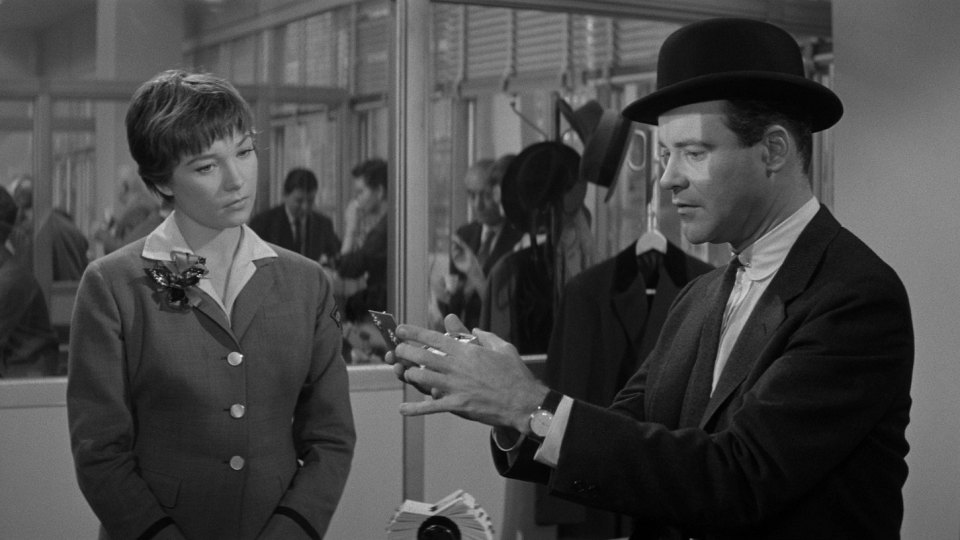
The moment The Apartment stops being a comedy fits in the palm of a hand. It is the office Christmas party, gin in paper cups, and C.C. Baxter has just been made a junior executive for services he is still pretending not to understand. He wants Fran Kubelik, the elevator girl he adores, to see him in his new bowler, so she hands him her compact and lets him admire himself. The glass is cracked. He has seen this compact before. He found it on his own couch after one of his boss’s borrowed evenings and handed it back up the org chart like the good soldier he is, and now here it is again, in the hand of the one person he had kept separate from all of that. Jack Lemmon does the hardest thing in his repertoire, which is nothing: the party keeps roaring, the hat stays on, and a man silently files the worst piece of information of his life. Fran watches him look too long and hands him the saddest line American comedy has produced: “I like it that way. Makes me look the way I feel.”
Wilder carried the idea for fifteen years before the culture would let him shoot it. He had seen Brief Encounter in 1945 and fixated on the one character that movie had no use for: the friend who lends the lovers his flat and comes home to warm sheets and somebody else’s perfume. What finally unlocked the script was a genuine scandal: in 1951 a Hollywood producer shot a talent agent over an affair with his wife, and the detail the town could not stop repeating was the venue, a junior employee’s borrowed apartment, lent upward. Between those two poles, an English weepie and a parking-lot shooting, sits the whole picture. Baxter is a clerk at Consolidated Life, desk 861, one of the thirty-one thousand souls he can quote statistics about, and four managers rotate his West Sixty-Seventh Street walk-up like a motel with no register. They phone in reservations the way other men book lunch tables. They pay in efficiency reports. When the personnel director Sheldrake smells the arrangement, he does not shut it down; he consolidates it, the way big fish handle small rackets, and Baxter gets a private office in exchange for the only private thing he had left.
The frames do the accusing before anyone speaks. Alexandre Trauner built the insurance floor in forced perspective, full-size desks and live extras up front shrinking row by row toward half-scale furniture at the horizon, so that Joseph LaShelle’s widescreen camera can look down an office that never ends. A man photographed in that set is not an employee; he is an entry. Baxter even narrates himself that way, reciting the population of New York and the payroll of Consolidated Life like a figure introducing the column he belongs to. Then the film moves to the apartment and the same lens goes warm and close, two shabby rooms that feel like the one heated pocket in the city, and the cruelty clicks into place: of course the company annexed it. It was the only real estate in the movie worth having.
Lemmon plays Baxter as a body keeping the count his mouth will not. He catches his famous cold waiting on a park bench, locked out of his own home while a manager entertains upstairs, and the sniffling runs the length of the film like an eviction notice that follows him indoors. He strains spaghetti through a tennis racket and sells it as ingenuity, and the gag lands twice, once as charm and once as the inventory of a man who has been alone so long his kitchen has adapted. Shirley MacLaine gives Fran the opposite instrument: stillness. Her elevator-operator courtesy is armor, and when she finally states her case, “some people take, some people get took,” she recites it flat, without self-pity, a woman reading her own file aloud. Between them stands Fred MacMurray, the second time Wilder stole America’s favorite nice guy for a villain, and Sheldrake is the better crime. He never seduces Fran; he administrates her. His idea of a Christmas gift, caught without one, is to peel a hundred-dollar bill from his clip and tell her to buy herself something. She goes quiet, and the overdose that follows is not a twist. It is the receipt.
What happens next was the most dangerous stretch of tone any American comedy had attempted: sleeping pills in one room, slapstick in the next, and neither cheapens the other because Wilder plays both at the tempo of work. Dr. Dreyfuss from next door slaps Fran conscious, walks her, pours coffee into her, and the movie holds its nerve by simply doing the next necessary thing, then the next. Then come two days of convalescence that contain the entire romance: gin rummy on the bed, spaghetti at odd hours, two shamed people discovering the novelty of being fussed over honestly. The film’s idea of intimacy is not a kiss. It is a card game with someone who has decided you should stay alive.
The Apartment is remembered now as the sweet ancestor of the office romance, and the memory is a flinch. Watch it again and it is the most exact American movie ever made about the annexation of home by work, a comedy in which every promotion is paid for in privacy and the top of the company is just the bottom with better furniture. Sixty-six years later the annexation is complete. The desk came home for good, the job holds a key to everybody’s apartment now, and Baxter’s shame turns out to have been nothing but early. That is what the years did to this film: they kept confirming it.
The honest charge against it has aged as well as its virtues, and it deserves a fair hearing. The film knows Baxter’s soul in full and knows Fran’s mostly by its bruises; her overdose functions, structurally, as his education, a conscience for the leading man charged to the leading lady’s account. And Wilder, who trusted objects more than any director of his generation, twice loses his nerve and lets the neighbor doctor speak the moral aloud, be a mensch, in case the cracked mirror had not already said it better. It had. What answers the charge, mostly, is MacLaine, who plays every scene as a woman doing sums of her own, and an ending that hands her the whole game. A champagne cork goes off upstairs like a pistol shot, and Fran runs toward the sound, toward instead of away, because Baxter once told her about the gun and his knee and the girl he botched his own heartbreak over, and for one flight of stairs the film lets her carry the fear he carried on Christmas Eve. Then his declaration, the bravest plain sentence in Wilder: “I absolutely adore you.” And her answer, shuffling: “Shut up and deal.” It is not a swoon. It is the first deal in the entire picture struck between equals, at nobody’s expense, with nothing changing hands but cards. The romance is not a reward for quitting the racket. It is what becomes possible the minute both of them are out of it.
That is why the film still sits where it sits, at the top of the American comedy, and why it belongs there on merit rather than nostalgia. It saw what the century was going to do to the space between love and work, and it fit the whole prophecy into one rented room with a tennis racket drying in the kitchen. The funniest thing Wilder ever made is also the most honest, and the two facts are not in tension. They are the same fact, cookie-wise.
LUNARA DEBRIEF
- Score: 5 / 5
- Year: 1960
- Where to Watch: VOD [all major platforms] | 4K UHD disc
- Theme Echo: Brief Encounter (1945) tt0037558. The film that planted the seed. Lean’s lovers borrow a friend’s flat and are chased out by shame; Wilder stayed on the friend and found commerce where Lean found guilt. Each film is the other’s missing reverse angle, and the borrowed room is the same room.
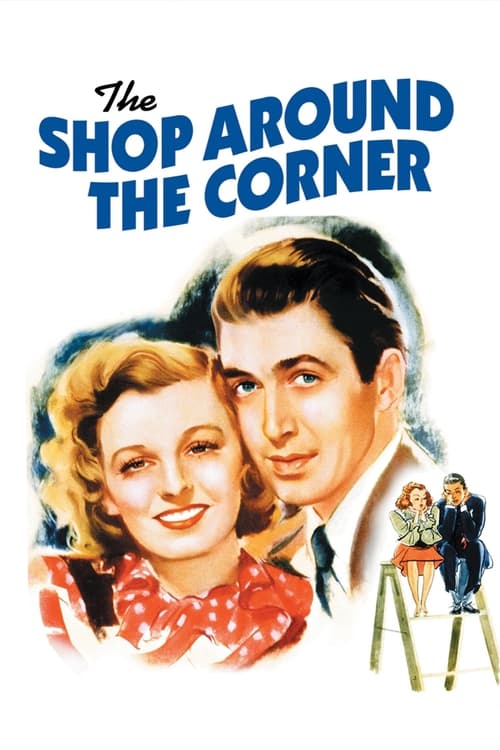
- Counter-Program: The Shop Around the Corner (1940) tt0032975. Wilder kept a sign in his office asking how Lubitsch would do it, and this is what Lubitsch did: a workplace where intimacy arrives by post instead of being traded up the org chart. Twenty years separate the two shops, and the distance between them measures what the American office learned to charge.
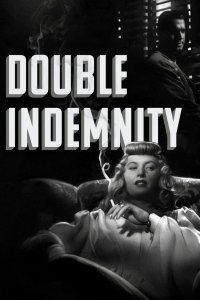
- Career Context: Double Indemnity (1944) tt0036775. The first time Wilder handed Fred MacMurray a rotten soul and the nicest man in America said yes. Walter Neff sells the policies and Sheldrake administers them; the straight line between those two performances is Wilder’s whole case against charm.
LUNARA DEBRIEF
- Score:★★★★★
- Oscar Ledger10 nominations • 5 wins
- Year:1960
- Where to Watch:DigitalFind Digital OptionsAvailability4K UHD disc
Pair It With
Three films in conversation with this one.

Theme Echo
Brief Encounter (1945)
The film that planted the seed. Lean's lovers borrow a friend's flat and are chased out by shame; Wilder stayed on the friend and found commerce where Lean found guilt. Each film is the other's missing reverse angle, and the borrowed room is the same room.
Counter-Program
The Shop Around the Corner (1940)
Wilder kept a sign in his office asking how Lubitsch would do it, and this is what Lubitsch did: a workplace where intimacy arrives by post instead of being traded up the org chart. Twenty years separate the two shops, and the distance between them measures what the American office learned to charge.
Career Context
Double Indemnity (1944)
The first time Wilder handed Fred MacMurray a rotten soul and the nicest man in America said yes. Walter Neff sells the policies and Sheldrake administers them; the straight line between those two performances is Wilder's whole case against charm.
Further Reading
More Lunara Criticism
 ★★★★★
★★★★★
Lunara Review
Watch trailerA.I. Artificial Intelligence
A.I. Artificial Intelligence is a fairy tale about a machine engineered to love a mother who can return that love only on her species' terms, and…
Updated August 12, 2026
 ★★★★★
★★★★★
Lunara Review
Watch trailerThe Odyssey — I Walked Right Back In
Nolan aimed the biggest camera on earth at the oldest story about going home -- and I walked out of the 70mm IMAX and bought a ticket to...
Updated July 28, 2026
 ★★★★½
★★★★½
Lunara Review
Guardians of the Galaxy Vol. 3 — The Wound Under the Fur
The last MCU film made by somebody who loved the characters more than the franchise, and it is about a raccoon, and it wrecked me.
Updated July 26, 2026
 ★★★★½
★★★★½
Lunara Review
Inside Out 2 — Anxiety Is Middle Management
Pixar's sequel knows the scariest thing in a thirteen-year-old's head is the employee who never sleeps.
Updated July 25, 2026
 ★★★★★
★★★★★
Lunara Review
Decision to Leave — Surveillance Is the Love Language
Park Chan-wook's detective romance understands the terrible secret of both professions: to investigate someone and to love someone are the same activity.
Updated July 25, 2026