
Lunara Review
Annihilation — What Walks Back Out
The scariest thing in Alex Garland's expedition film is not what waits inside the zone; it is what walks back out wearing your name.

The scariest thing in Alex Garland’s expedition film is not what waits inside the zone; it is what walks back out wearing your name.
A soldier comes home after a year of silence. His wife is repainting their bedroom when he appears in the doorway, and everything about the reunion is technically correct: he sits, he answers, he drinks the glass of water she pours him. But the answers arrive a half-beat late, sanded of detail, as if relayed from somewhere with a delay, and the man who left on a classified mission seems to be reciting the husband rather than being him. Then blood blooms in the water glass, the ambulance is run off the road by government SUVs, and Annihilation declares its true genre. This is a horror film about the self as foreign territory, a journey into biological dissolution that doubles as a map of grief, guilt, and the parts of a person that quietly want to stop existing.
The setup is told with unusual economy for a film this strange. Three years ago something fell out of the sky and struck a lighthouse on the American coast, and around the impact grew the Shimmer, a prismatic membrane expanding by the month. Expeditions go in; nothing comes out except, now, Kane, his organs failing for reasons medicine cannot name. His wife Lena, a cellular biologist who used to be a soldier herself, joins the next team: five women walking into the zone to reach the lighthouse before the zone reaches everyone else. Inside, biology has stopped obeying its own laws. DNA refracts like light through a prism. Flowers of different species bloom from a single stem. Animal tracks change species mid-stride. The boundary between self and environment has become a suggestion.
Alex Garland adapts Jeff VanderMeer’s novel not as translation but as possession, keeping the mood and inventing nearly everything else, and Paramount famously lost its nerve, worried the result was too cerebral for a wide audience and handing most of the world a streaming release instead of a screen. The worry was not irrational; the film validates it at every turn by declining to explain itself. That is also why it remains one of the decade’s most visually ambitious science fiction pictures and one of its least chaperoned: nobody made Garland put the answers back in.
Natalie Portman plays Lena as someone already partway dissolved before she crosses the boundary. The affair that cracked her marriage has left a guilt that behaves like an autoimmune disorder, a self attacking itself, and Portman keeps the register deliberately constricted: scientist’s detachment, survivor’s dissociation, or something else, the film never rules. The opacity is the power. You assemble her from fragments and flashbacks, never sure which Lena is the original, and by the end Portman is performing something that may not be Lena at all, locating the uncanny in stillness and the slightly wrong angle of a gaze. Around her, Jennifer Jason Leigh’s Dr. Ventress runs the expedition on a flat affect pitched exactly between clinical distance and death-drive surrender, and delivers the film’s center of gravity in one line: “Almost none of us commit suicide, and almost all of us self-destruct.” Every woman on the team is carrying her own version of that sentence. The Shimmer does not so much attack them as agree with them.
What they find inside is mutation staged as art. Rob Hardy floods the frame with light that comes from everywhere and nowhere, the palette sliding from green and gold into hues with no terrestrial reference, and the production design imagines transformation as a kind of authorship: bodies become gardens, bones become coral, a corpse flowers against a swimming-pool wall like a mural painting itself. The bear is the masterpiece of the approach, a predator that has absorbed not just a dead woman’s flesh but her dying scream, and replays her voice through its own throat to call the others in. It weaponizes the one sound the genre holds sacred, the scream that means a self is still in there, and it makes the scene it stalks, three women tied to chairs in a ruined living room, into one of the most frightening sequences of its decade. Ben Salisbury and Geoff Barrow’s score undergoes the same infection, opening on acoustic guitar and folk textures and ending in an electronic pulse that breathes and cannot be located, the music mutating in sync with everything on screen.
The structure runs the infection through the film itself. Editor Barney Pilling cuts between the expedition and Lena’s quarantine debriefing afterward, and the frame story is no framing device: it is the same wrongness at one remove, a woman recounting events she may not remember accurately, to authorities she has no reason to trust, about a person who walked out of the zone answering to her name. The cuts land on discontinuity, each jump revealing how much has been replaced.
All of it converges on the lighthouse, and the lighthouse earns the word audacious. In the crater beneath it Lena meets something that is not quite alien and not quite her reflection, a humanoid figure condensed out of shimmer-stuff that mirrors her movements with a small translation delay, then without one, then ahead of her. Their wordless dance, scored to the cascading cue called “The Alien,” is the whole film compressed: identity not stolen but refracted, multiplied, distributed, a self being overwritten faster than it can insist on itself. When Lena finally puts a burning phosphorus grenade in the thing’s hands, neither she nor we can say whether she is killing it or handing herself over, and the charred figure seated against the wall could be her husband, a copy, or the question mark the film intends to leave. Something survives and walks out. Whether it is Lena depends on definitions the film keeps to itself.
The fair knock is the middle. The expedition roster runs on subtraction logic, four companions introduced roughly in the order the Shimmer will collect them, and apart from Ventress only flickers of interior life get through before the collecting starts; Tessa Thompson’s Radek receives one devastating exit, the scars on her forearms flowering as she walks into the meadow, but the team are case studies first and women second, and for a stretch you can feel the diagram under the dread. It costs the film exactly as much as that sounds like it would cost, and not one frame more, because the ending pays everything off: Lena embracing a man who is probably not her husband, her eyes flickering with borrowed light, the question of what survived left standing because it cannot be answered, for her or for anyone who has come out the far side of a catastrophe wearing the old name. Annihilation treats horror as speculation rather than jolts and locates the terror in biology instead of intruders, and it leaves behind the one idea almost no film will touch: that what emerges from destruction might be more beautiful than what went in, and that there may be no difference between transforming and being destroyed.
LUNARA DEBRIEF
- Score: 5 / 5
- Year: 2018
- Where to Watch: Streaming (Paramount+; Netflix outside the US) | VOD (major platforms)
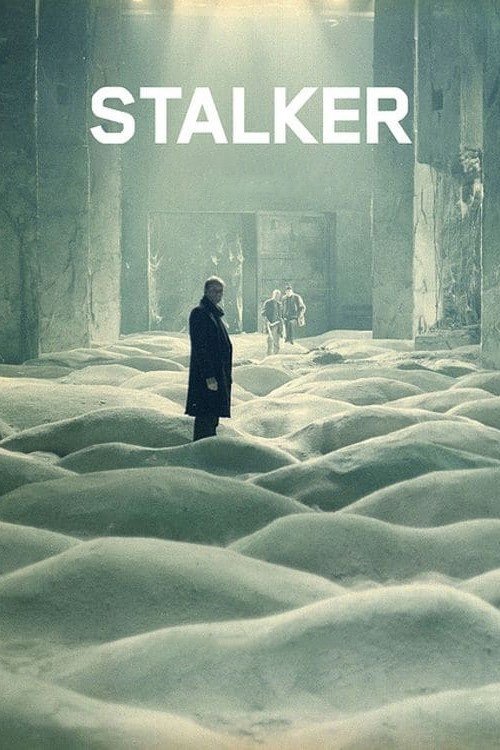
- Theme Echo: Stalker (1979) tt0079944. The Zone before the Shimmer: Tarkovsky’s anomalous territory also answers the people who enter it rather than attacking them. Both films understand that a place where wishes and wounds become material is scarier than any monster, because the intruder it reflects is you.
- Counter-Program: Arrival (2016) tt2543164. First contact as communion instead of dissolution: Villeneuve’s aliens hand a grieving woman a language that heals; Garland’s phenomenon absorbs a grieving woman and hands back a translation. The decade’s optimist and pessimist cases for the same encounter.
- Career Context: Ex Machina (2014) tt0470752. Garland’s debut runs the same experiment in a locked room: something new studies a human, learns the shape, and walks out wearing it into the world. Scale the glass cell up to a coastline and you have the Shimmer.
LUNARA DEBRIEF
- Score:★★★★★
- Year:2018
- Where to Watch:
Pair It With
Three films in conversation with this one.
Theme Echo
Stalker (1979)
The Zone before the Shimmer: Tarkovsky's anomalous territory also answers the people who enter it rather than attacking them. Both films understand that a place where wishes and wounds become material is scarier than any monster, because the intruder it reflects is you.

Counter-Program
Arrival (2016)
First contact as communion instead of dissolution: Villeneuve's aliens hand a grieving woman a language that heals; Garland's phenomenon absorbs a grieving woman and hands back a translation. The decade's optimist and pessimist cases for the same encounter.

Career Context
Ex Machina (2014)
Garland's debut runs the same experiment in a locked room: something new studies a human, learns the shape, and walks out wearing it into the world. Scale the glass cell up to a coastline and you have the Shimmer.
Further Reading
More Lunara Criticism
 ★★★
★★★
Lunara Review
Men — One Face, Every Man
One word on the poster, one face on every man, and a hundred minutes of images trying to close the gap.
Updated July 25, 2026
 ★★★★★
★★★★★
Lunara Review
Ex Machina — The Test Was for You
The test was never for the machine.
Updated July 25, 2026
 ★★★★½
★★★★½
Lunara Review
Avengers: Infinity War — The Night the Theater Went Silent
The boldest thing a franchise ever did was assemble everyone and then let the villain finish.
Updated July 25, 2026
 ★★½
★★½
Lunara Review
Ant-Man and the Wasp — The Sorbet Course
Two hours of pleasant weightlessness, and thirty seconds after the credits that outweigh all of it.
Updated July 25, 2026
 ★★★★½
★★★★½
Lunara Review
A Quiet Place — Parenthood at Full Volume
The monsters hunt by sound; this family was already fluent in silence.
Updated July 25, 2026