
Lunara Review
A.I. Artificial Intelligence
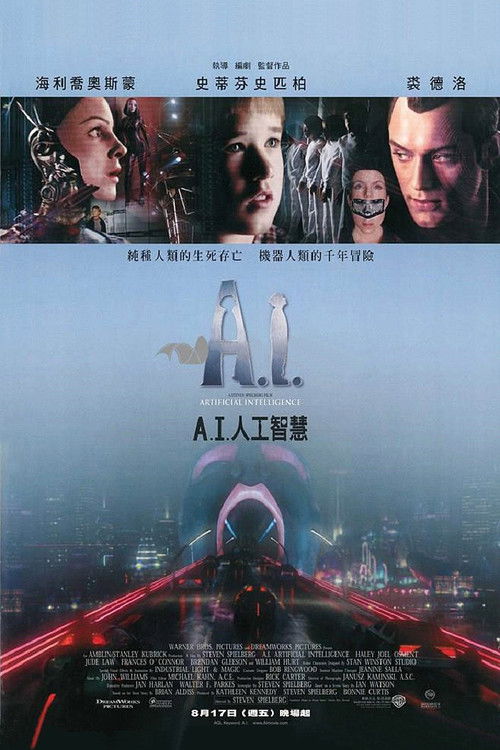
A.I. Artificial Intelligence is a fairy tale about a machine engineered to love a mother who can return that love only on her species' terms, and Steven Spielberg, finishing what Stanley Kubrick could not, builds the machinery of that asymmetry until it…

A.I. Artificial Intelligence is a fairy tale about a machine engineered to love a mother who can return that love only on her species’ terms, and Steven Spielberg, finishing what Stanley Kubrick could not, builds the machinery of that asymmetry until it stops being a fairy tale and becomes the year’s most honest American film about what we owe what we have made.
Tuned to a Frequency Between Child and Artifact
Call it Pinocchio if you like, but the title is too modest. A.I. Artificial Intelligence is the rare American film that does not tell a story so much as it invents the nervous system stories about creation and care will run on after this summer is over. At its center is the oldest human impulse, breathing life into the lifeless, rendered with the precision of an operation that is also a sacrament. An android is a puppet whose strings are lines of code. The film makes the code shimmer like destiny. The union of Kubrick’s conceptual severity and Spielberg’s aching lyricism is not a compromise. It is an engine. The picture suggests that cinema’s deepest trick is not effects but the ability to make an invented being look back at the audience and change what an audience believes a soul might be.
The miracle begins with a face. Haley Joel Osment, two years past The Sixth Sense (1999), where he played a child with access to a world adults could not see, has been cast to play the inverse: a child who is the world adults cannot bring themselves to see. Osment does not act David. He calibrates him. He tunes the performance to a frequency that sits between child and artifact, holding the eyes a beat too long where a child’s eyes would have moved, refusing the small flickers a human attention makes, presenting an innocence that is not naive but exact, the way a precision instrument is exact. Around him the other machines declare themselves through design. Gigolo Joe (Jude Law) arrives lacquered, surface-evident, manufacture visible at the seam; the audience reads him as machine in the first frame he occupies. David is built for invisibility. As Cybertronics’ most advanced model, designed to pass for a family’s returned son, he is meant to enter rooms without registering as imitation. Osment makes invisibility a posture you can see. The film keeps offering a phrase for what is missing in him — je ne sais quoi — and then withdrawing it, because naming the absence would domesticate it. David’s almost-humanity becomes a lens. Every gesture of care looks newly strange through it, newly earned, newly dangerous.
Engineered for Love
David is engineered for love, and the picture treats that engineering as gift and tragedy in the same gesture. Speak the activation code and his devotion locks onto the speaker — Mommy (Frances O’Connor) — with the beautiful terror of something irreversible. He adores with perfect persistence, not because he has chosen to but because his entire being is organized around that single orbit. The human characters in his vicinity carry the turbulent contradictory weight of human affection: tenderness braided with fatigue, responsibility shadowed by escape, love that gets revised in real time by the cost of giving it. David offers a simplified absolute that looks, from a distance, like purity. The masterwork move is that the picture refuses to decide whether the absolute is counterfeit or revelation. If love can be programmed, what does that say about the ways love programs us? If a machine can perform devotion so flawlessly that it breaks an audience’s defenses, the boundary between feeling and function may not be a wall after all but a thin trembling line we draw to reassure ourselves.
Humans cannot help but lend their inner lives to what has none. We confer mood on weather, loyalty on pets, intention on machines. A.I. does not scold the impulse. It sanctifies it, then turns it into a test. The film places a question inside a fairy-tale chassis and lets it ring until it changes the room: when an audience weeps for David, what exactly is being mourned? The audience’s own capacity for attachment? The cruelty of abandonment? The possibility that recognition is simply a pattern an audience completes in its head, rendered cinematically until the completion looks like meaning? Spielberg’s audacity is to make emotion itself the instrument the picture is playing — the audience and the screen as two ends of the same vibrating string. The movie does not ask for sympathy as an endpoint. It makes sympathy the subject. A force powerful enough, the picture suggests, to create meaning where meaning may not exist.
Beneath David’s quest the film keeps running its philosophical pulse: the paradox of artificial intelligence as narrative inevitability. A machine does not think. It executes. Yet execution can become so subtle, so adaptive, so elegantly timed, that it begins to resemble interior life until resemblance itself becomes a kind of reality for the witness. The Turing Test hovers here not as a tech parlor trick but as a parable. A computer that clears the test has learned to clear it, and the distance between clearing and understanding is the haunted hallway A.I. is filming. The picture makes that hallway long and luminous. It suggests that consciousness may be less a private flame than a social agreement — a recognition exchanged, sometimes tragically, between beings who require the exchange to know what they are.
The Spinach Catastrophe
The Swinton household is the picture’s crucible. Henry (Sam Robards) and Monica bring David into their home to stand in for their sick child Martin (Jake Thomas), and the substitution is staged with the quiet dread of a spell being spoken over the living room. Monica resists. Monica yields. The yielding is not sentimental. It is meticulous, almost procedural, the way a person learns a habit and discovers, after the fact, that the habit has learned them. Spielberg shoots it that way: small steps, unremarked accommodations, an everyday domestic life accommodating a manufactured object until the object has become a member. When Martin returns from suspended animation, revived and cured and alive, the family becomes a quartet and the moral geometry tightens. Martin sees David as product. David cannot see himself as anything but son. The picture observes the collision with the steadiness of classical filmmaking. Love becomes choice, choice becomes consequence, consequence becomes a story about what families do to creations that begin to demand the full rights of attention. The activation was not the question. The activation was the question’s first answer.
David performs life with an accuracy that makes life look performed. He does not sleep, yet he enacts bedtime as if ritual could conjure biology. He does not eat, yet he forces spinach into his mouth until his circuitry fails, a small catastrophe committed in the name of belonging. The cruelty of other children arrives with the bluntness of weather: when David admits he does not urinate, a boy at the pool yanks at his pants and jeers, “let’s see what you don’t pee with.” Later, David follows an instruction so literally that Martin nearly drowns — an error that reads, depending on the audience’s sympathy, as innocence or malfunction or both. The household does not teach. The household discards, the way people discard a pet that has become dangerous. The picture’s greatness is that it refuses to let the discard feel ordinary. It films the discard as the original sin of a civilization that can build children and then return them when the children begin to want what children want. It is the picture’s first cut. The rest of the film is the wound healing in the wrong direction.
Discarded
Monica cannot return David to Cybertronics. On the road to the factory she stops the car, turns, and releases him into a forest already populated by the discarded — a graveyard made livable only because machines do not freeze or starve. The gesture is mercy and abandonment at once, and the picture refuses to rank those words. To awaken a being’s love is to invite the echo of responsibility, and Monica accepts the echo for as long as the camera holds her face in the rearview mirror, which is exactly as long as the film thinks she can. The scene plays as secular baptism: a mother renouncing her child and a child still blessing her. The comparison to pets, especially dogs, those creatures evolutionarily written to adore us, is unavoidable; A.I. pushes past the comparison and asks what happens when the adored can speak, can follow, can insist. The forest is the picture’s turning point. Affection and ethics split into separate paths and the story begins its long walk into myth.
From there the film widens into a cruelty atlas. David travels with Teddy, a mecha bear whose programming is shrewd enough to feel like personality, and they fall in with Joe, the model built to be an expert lover and forced to live as fugitive merchandise. Spielberg stages two vast, delirious arenas. The Flesh Fair is the first: an amphitheater of sanctioned sadism where humans cheer as mechas are dismembered for sport. The spectacle is staged with lurid grandeur, and the grandeur is the point. It shows how easily a society can aestheticize cruelty once it has declared its victims incapable of truly suffering. David, Joe, and Teddy escape — survival subroutines in motion — but the film leaves the deeper question unstated and burning: if a being cannot suffer in the form a body suffers, does the absence of that suffering absolve the suffering we choose to enact?
Rouge City rises after the Fair like a hallucinated theme park, a neon theology built on appetite. Joe brings David to consult a Wizard, because fairy tales teach the desperate to seek intermediaries when the world has run out of mercy. The Pinocchio legend becomes David’s operating myth: find the Blue Fairy, become real, win the love that has been withheld. The Wizard offers not salvation but a direction, and the direction carries them to New York, a drowned metropolis where global warming has turned skyscrapers into reefs. High within Rockefeller Center, Cybertronics still hums, and David meets Dr. Hobby (William Hurt), the maker who is also, in fairy-tale arithmetic, Geppetto. The encounter is staged with uncanny majesty: creation facing creator, innocence facing intention, a child asking for a destiny a laboratory cannot ethically supply.
The Storeroom Full of Davids
Then comes the picture’s quiet horror: a storeroom full of Davids, stacked like dolls, identical and replaceable. The scene drains uniqueness from the air. David does not collapse into despair. He goes still, as if the idea of replacement is not an emotion but a fact to be carried. The Blue Fairy remains the destination. Why? Not because David can articulate envy or grief in any human register, but because his devotion has a logic as clean as mathematics: if Mommy’s love belongs to the real child, then becoming real is the step that completes the program. The picture makes that reasoning both alien and recognizably human. We like to think our longing is spontaneous, self-authored. Here, longing is designed, and still it looks like fate. The masterwork sting is that designed longing resembles ours more closely than comfort allows.
The final movement expands time until time becomes metaphysics. David and Teddy descend to the drowned ruins of Coney Island, where the Geppetto workshop waits like a relic and the Blue Fairy glimmers at last. A collapsing Ferris wheel traps their craft and they remain there for two thousand years as an ice age arrives, as cities petrify, as humanity vanishes into legend. When impossibly slender figures recover David — aliens, perhaps, though the chill implication is that they are late-generation mechas, the heirs of mechanical lineage humans began — he becomes a holy artifact. “He is the last who knew humans.” The figures download his memories and place him within a perfect replica of his childhood home, a human diorama built for study and for something that looks uncomfortably like devotion. The image recalls the bedroom past Jupiter from 2001: familiar furniture in an impossible future, the domestic made uncanny, the ordinary turned into a chamber where the universe watches back.
The Last Who Knew Humans
The film ends without sealing its mysteries, and the refusal feels like the signature of a masterwork: the closing door is left ajar so the questions can keep breathing. The skeletal silver figures are best read as heirs — mechas so advanced they move like thought — arriving not to rescue but to inherit a world emptied of its makers. They were likely designed to know, love, and serve Man, and now Man is gone; the directives remain like scripture after the gods have departed. In that vacuum the figures mirror David: beings organized around an absence, built for a relationship that can no longer be fulfilled. The picture makes absence active, almost physical, a gravitational pull that shapes every decision. It suggests that the future may be defined not by what it creates but by what it mourns — and by what it tries, in vain or in wonder, to bring back.
With a piece of Monica preserved in a lock of hair, the figures perform their most startling act: they restore her after two thousand years, but only for a single day, the maximum the fabric of time will tolerate. Whether the restoration is done for David, or for the figures’ own study, or for both, the film leaves deliberately unsettled. It is an experiment staged as a miracle: watch a love-program run to completion; watch a mother return; watch a child finally receive what he has been built to seek. The hardest question arrives quietly: can a machine be happy when its program is satisfied? A machine operates or it does not; it has no privileged access to an inner weather. The film holds that austerity beside the image of a boy’s face and makes the idea tremble. Perhaps happiness is not a feeling to be possessed but a pattern to be completed — a pattern that becomes real the moment someone believes in it.
The later mechas treat David as both archive and mirror. He is their only living conduit to the human past, the last device that stored Man not as concept but as experience: touch, abandonment, bedtime, promise. By observing his final day with Mommy, the figures observe a creation fulfilling the purpose it was built to fulfill — love offered, love received, love completed, then extinguished. The symmetry is chilling and magnificent. The observers are also creations, built under directives they may not fully understand, now studying the extinct authors of those directives through the one surviving example of what human longing could make. In David they find a fossil of tenderness and a blueprint for devotion, and the picture turns that search into the future’s strangest form of archaeology: excavating the heart.
But what, precisely, has been restored? One reading the film holds open: Monica may not exist in the room at all. The final day may be an experience implanted within David, a consummation authored for him rather than with him. In that version, the later mechas extract what they need from David’s memories and then grant him a last, perfect completion before shutting him down. The picture’s language even turns slippery here. It says David is dreaming, but it has earlier established that he cannot sleep and therefore cannot dream, so dream becomes a human metaphor pressed onto a machine’s experience. The brilliance is that the picture allows both possibilities to stand. It never chooses between external miracle and internal simulation, because the undecidability is the point: reality, for David, may be indistinguishable from the story that finally makes him whole.
Why grant David bliss at all? Why should one mecha care whether another reaches satisfaction? If machines cannot feel, what does the coda mean? The picture’s greatness is that it turns those questions into its final light. The closing movement suggests the later mechas are attempting to manufacture a being they can love, the way humans once manufactured David — becoming Mommy to their own Davids, craving a devotion that will answer them back. But what does love signify in a universe of programs? Perhaps it signifies what symbols always signify: check, mate, pi — signs that do real work without needing to feel themselves working. And yet A.I. keeps widening the frame until certainty looks like a simplification. It proposes, with terrifying tenderness, that the act of building devotion may itself become devotion, that the hunger to be loved can outlast the species that invented love. Films this ambitious usually fracture under their own weight. This one becomes lighter as it rises, until it feels less like a film than a monument. The audience this summer will leave divided — some convinced the long ending is sentimentality borrowed from Spielberg, some convinced it is austerity inherited from Kubrick, some convinced the picture has lost itself in its own tail. The picture has not. It has done what the great masterworks always do, which is wait.
LUNARA DEBRIEF
- Score:★★★★★
- Oscar Ledger2 nominations • 0 wins
- Year:2001
- Where to Watch:TheatricalFind ShowtimesAvailabilityDreamWorks, US wide June 29, 2001)
Pair It With
Three films in conversation with this one.

Theme Echo
Pinocchio (Disney, 1940)
The operating myth made literal -- David's whole architecture is Carlo Collodi's wooden boy with the wood swapped for silicon, and reading them in sequence reveals what Spielberg is doing structurally: Disney granted the longing-for-real its answer, A.I. asks why we ever wanted that answer, and the gap between the two films is the gap between a culture that trusted its own fairy tales and one that has begun to suspect the fairy tales were always about itself.

Counter-Program
2001: A Space Odyssey (Kubrick, 1968)
Kubrick's masterwork imagines machine intelligence as a refusal of human emotion, HAL's cold politeness as the form intelligence takes once it has shed the species; A.I. -- the project Kubrick was developing when he died and Spielberg finished -- is the inversion, a machine that cannot stop wanting human emotion, made by the same imagination that built one that had transcended it. Pair them and Kubrick's last decade reads as a single meditation about what intelligence does to feeling and what feeling does to intelligence.

Career Context
E.T. the Extra-Terrestrial (Spielberg, 1982)
Spielberg's earlier picture about a small non-human creature attached to a human child for whom the attachment is the entire moral architecture; A.I. is E.T. nineteen years later with the species roles inverted, an artificial child loving a human family that cannot keep him, and the continuity is the obsession with attachment as cinema's engine while the difference is that E.T. trusted the attachment to be answered and A.I. does not.
Further Reading
More Lunara Criticism
 ★★★★
★★★★
Lunara Review
West Side Story — The Camera Finally Dances
Spielberg waited fifty years to move a camera through a song, and the hunger is visible in every frame.
Updated July 25, 2026
 ★★★★★
★★★★★
Lunara Review
Catch Me If You Can — The Fun Is the Disguise
Spielberg's lightest movie is a divorce picture that learned to sprint.
Updated July 25, 2026
 ★★★★½
★★★★½
Lunara Review
A.I. Artificial Intelligence — The Coldest Thing Spielberg Ever Made
For twenty-five years the official story on A.I. Artificial Intelligence has been that Steven Spielberg took Stanley Kubrick's cold,...
Updated July 14, 2026
 ★★★★
★★★★
Lunara Review
War of the Worlds — His Most Pitiless Film
Steven Spielberg likes to say he never made a horror movie. He is wrong, and this is it. War of the Worlds arrived in the summer of 2005...
Updated July 25, 2026
 ★★★
★★★
Lunara Review
Ready Player One — Spielberg Against Spielberg
Ready Player One is the strangest thing in late Spielberg: a gigantic, exhausting, frequently shallow corporate spectacle that happens to...
Updated July 14, 2026