
Lunara Review
Capote — The Ending Needed Them Dead
A film about a masterpiece whose bill was paid mostly by other people.
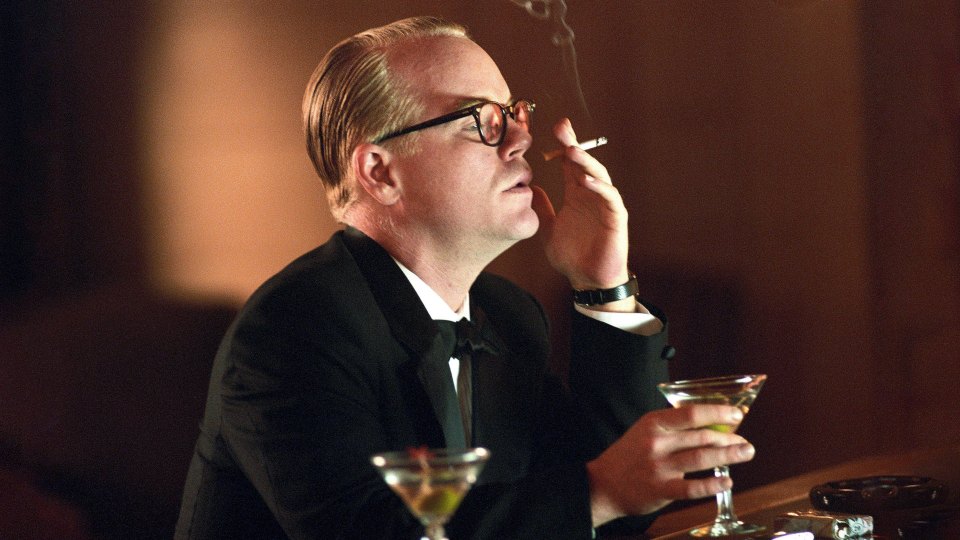
A film about a masterpiece whose bill was paid mostly by other people.
The tenderest scene in Capote is also its most damning. Perry Smith, on hunger strike in a Kansas cell, is wasting toward a death that would be inconvenient, and Truman Capote comes to him with a jar of baby food and spoons it into his mouth a little at a time, murmuring, patient as a nurse. Bennett Miller shoots it close and quiet and lets both truths sit in the same frame: the care is real, and it is also maintenance. The writer is keeping his source alive the way a farmer waters a crop. Nothing in the film ever resolves that doubleness, because the film is about a man who could not resolve it either, and who got his masterpiece at the exact price of finding out which half of himself was load-bearing.
The story starts with a newspaper item. November 1959: a wheat farmer named Herb Clutter, his wife and two teenage children, bound and shotgunned in their house outside Holcomb, Kansas. Capote, already the most famous literary voice in New York, reads three hundred words in the Times and smells the book that will invent a genre. He arrives in Kansas in a scarf the length of a manifesto, with Nelle Harper Lee as his advance team, and the film’s early stretch is a low comedy of access: Lee opening farmhouse doors his flamboyance slams, the town’s suspicion melting under his Bogart anecdotes, the lead detective’s wife setting an extra place because celebrity is a solvent even in grief country. Then the killers are caught, and the project changes shape. Perry Smith is sensitive, self-mythologizing, half Cherokee, all wound, and Capote recognizes him the way you recognize a mirror in bad light. He tells Lee the sentence the whole film balances on: it is as if he and Perry grew up in the same house, and one day Perry stood up and went out the back door while he went out the front.
What the film understands, and what makes it the best movie yet made about the true-crime economy, is that the relationship was a transaction wearing the clothes of a friendship, and that the writer was the only party who ever saw the books. Capote bribes his way into the cells. He hires the appeals lawyer himself, early, when the men dying too fast would cost him his material. He extracts Perry’s journals, his childhood, finally the night of the murders itself. And then the ledger flips: the book cannot end until they hang. The film’s structure is a slow, appalling inversion in which the stays of execution Capote once funded become the obstacle, and the man who whispered same house, Perry, becomes the delay between a genius and his ending. Miller never states the flip. He lets you watch it arrive in increments of avoidance: unanswered letters, a reading tour, the title. Capote swears to Perry’s face that the book has no title yet. Cut to a packed hall in New York, the author performing the Clutter murders to a rapt audience under a lobby card reading In Cold Blood. The lie is the film’s smallest crime and somehow the one that stings worst, because it is the one that cost him nothing.
Miller’s craft runs on withholding. Kansas is shot in wides flat as a ruled page, horizon like a sentence with no comma coming, and the interiors stay underlit, faces half-guessed in lamp glow; Mychael Danna’s piano score keeps its hands folded for minutes at a time. The stillness has a function: it makes Capote’s voice the loudest object in every room he enters, which is the portrait. Here is an instrument that cannot stop playing, set down inside a silence it plans to harvest. Philip Seymour Hoffman does the rest, and the feat is not the voice, which any impressionist could rent. It is the calibration underneath: the same anecdote pitched one way for a Manhattan party and another for a Kansas kitchen, seduction retuned per audience like a man adjusting a dial he was born holding, and, in the late passages, the sound of that instrument beginning to disgust its owner. Hoffman lets sincerity and performance share a single breath, so you can never once catch the seam, because there was no seam; that is the tragedy the film is written in.
Two decades of content have only sharpened its aim. Capote arrived before the boom, before the podcasts and the docuseries and the streaming queues where other people’s worst nights are refined into episodes, and it pre-litigated the entire industry: the access bargain, the empathy that doubles as extraction, the audience, us, filling the hall at the reading, moved to reverent silence by four deaths retailed in perfect prose. The film’s reappraisal case is simple: in 2005 it looked like an awards-season portrait; from here it looks like a warning label the culture peeled off and discarded.
For all that, the prosecution is a little too airtight. In its back half the film stacks the deck, draining the charm that made the whole story possible; we are told everyone adored this man, but the movie grows so intent on the reckoning that it stops letting us feel the adoration ourselves, and Dewey, Shawn, and the devoted Jack Dunphy flatten into a moral chorus. Sharper still: Dick Hickock barely exists. The film chooses the soulful killer and files the other as a prop, which is precisely the distortion Capote himself committed, reproduced without being marked as his. Call half of that a diagnosis and the other half a debt. The film survives both, because its final movement is as exact as an American movie has ever been about guilt. Capote attends the hanging because Perry asks him to. Miller shoots the execution as procedure, harness and hood and duration, no music to hide in. And then the phone call to Nelle, the wrecked voice insisting there was nothing he could have done to save them, and her reply, gentle as a verdict: maybe not, but the fact is, you did not want to.
The title cards finish it like a tombstone: In Cold Blood made him the most celebrated writer in America, and he never finished another book. The film’s last mercy is that it lets him know why. Everything afterward, the talk shows, the drink, the two decades of an unwritten novel whose epigraph he had already chosen, about the tears shed over answered prayers, plays as a sentence being served in public. Capote is a five-star film because it holds the two facts its subject could not: the book is immortal, and the man was billed for it monthly, until the account closed.
LUNARA DEBRIEF
- Score: 5 / 5
- Year: 2005
- Where to Watch: VOD [all major platforms] | Sony Pictures Classics disc
- Theme Echo: Nightcrawler (2014) tt2872718. The extraction economy at its id. Lou Bloom shoots the wreckage Capote transcribes, one selling to late-night news and the other to literature, and the pairing leaves exactly one difference standing: the thread count of the prose.
- Counter-Program: In Cold Blood (1967) tt0061809. The book filmed with the author deleted: killers centered, method documentary, the same gallows staged as fact instead of reckoning. Watch them as a diptych. Brooks shows what Capote wrote; Miller shows what writing it did.
- Career Context: Foxcatcher (2014) tt1100089. Miller’s other study of a patron who collects a human being and calls it love. Du Pont acquires wrestlers the way Capote acquires access, and both films turn on the same instant: the moment the specimen notices the jar.
LUNARA DEBRIEF
- Score:★★★★★
- Oscar Ledger5 nominations • 1 wins
- Year:2005
- Where to Watch:DigitalFind Digital OptionsAvailabilitySony Pictures Classics disc
Pair It With
Three films in conversation with this one.
Theme Echo
Nightcrawler (2014)
The extraction economy at its id. Lou Bloom shoots the wreckage Capote transcribes, one selling to late-night news and the other to literature, and the pairing leaves exactly one difference standing: the thread count of the prose.

Counter-Program
In Cold Blood (1967)
The book filmed with the author deleted: killers centered, method documentary, the same gallows staged as fact instead of reckoning. Watch them as a diptych. Brooks shows what Capote wrote; Miller shows what writing it did.

Career Context
Foxcatcher (2014)
Miller's other study of a patron who collects a human being and calls it love. Du Pont acquires wrestlers the way Capote acquires access, and both films turn on the same instant: the moment the specimen notices the jar.
Further Reading
More Lunara Criticism
 ★★★★★
★★★★★
Lunara Review
Cache — Guilt Has a Fixed Address
The question was never who sent the tapes; it is why one man needed them to stay a mystery.
Updated July 25, 2026
 ★★★★★
★★★★★
Lunara Review
A History of Violence — The Mask Grows In
Cronenberg's American postcard, with the blood already in the frame.
Updated July 25, 2026
 ★★★★½
★★★★½
Lunara Review
Batman Begins — My Batman
Everyone has their Batman. Mine showed up on opening night in 2005, sitting between my grandparents, when a filmmaker finally took a man...
Updated July 20, 2026
 ★★★★
★★★★
Lunara Review
War of the Worlds — His Most Pitiless Film
Steven Spielberg likes to say he never made a horror movie. He is wrong, and this is it. War of the Worlds arrived in the summer of 2005...
Updated July 25, 2026
 ★★★★★
★★★★★
Lunara Review
Watch trailerA.I. Artificial Intelligence
A.I. Artificial Intelligence is a fairy tale about a machine engineered to love a mother who can return that love only on her species' terms, and…
Updated August 12, 2026