

Out of Order!, 2025
Out of Order! — The Reunion the Movie Doesn’t Know It Has
Movie Review
Nineteen years after Superman Returns, Brandon Routh and Sam Huntington are best friends again, and the farce around them never notices what it has.
The best room in Out of Order! is a two-desk storefront law office in Los Angeles. Two earnest men, one coffeepot, and a back-and-forth patter so easy you can tell nobody had to rehearse it. That ease has a history. Nineteen years ago Brandon Routh put on the cape and Sam Huntington put on the Jimmy Olsen bowtie, and Superman Returns asked a theater full of strangers to believe a man could fly. Now, in Guy Jacobson’s dual-identity legal farce, which lands in Dallas this Saturday at the USA Film Festival after opening the Chelsea Film Festival last October, the two of them are sharing frames again as deadbeat-lawyer best friends. That reunion is the most valuable thing the movie owns. The movie has no idea.
Here is the setup, and it is a good one. Routh plays John Slater, a rumpled young attorney whose supermodel girlfriend Lisa, played by Tao Okamoto, walks out in the opening minutes because he takes her for granted. Desperate to win her back, Slater says yes to a high-powered Beverly Hills firm run by Brooke Shields. One catch. His old boss at the shoestring practice will not let him go until he finishes one last pharmaceutical case, and that case turns out to be the very one Shields’s firm has been hired to fight from the other side. So Slater buys a blonde wig, blue contact lenses, and a fake mustache, and works the defense in Beverly Hills while his real face, and his real best friend, stay on the plaintiff side. One man, two disguises, one lawsuit, zero legal ethics. That is honest old-studio machinery, the kind of contraption nobody builds anymore, and I wanted it to run.
It does not run, and you can hear exactly why. Listen to Shields’s character, who keeps calling Slater “weird but cute.” She says it at his job interview. She says it in meetings. She says it across a boardroom. That is not a running joke. A running joke escalates; this one just recurs, a script deciding that a two-word reaction is a complete reaction and then never building the second beat. Once your ear catches it there, you catch it everywhere: characters explaining their feelings instead of revealing them, announcing their objectives instead of chasing them, landing on the same note because the writing never wrote them another. Screwball is the cruelest register in comedy for precisely this reason. It has to be stylized and still sound like something a human being might blurt under pressure. What is on screen here is stylized and inert, written like explanation and delivered like a first read-through.
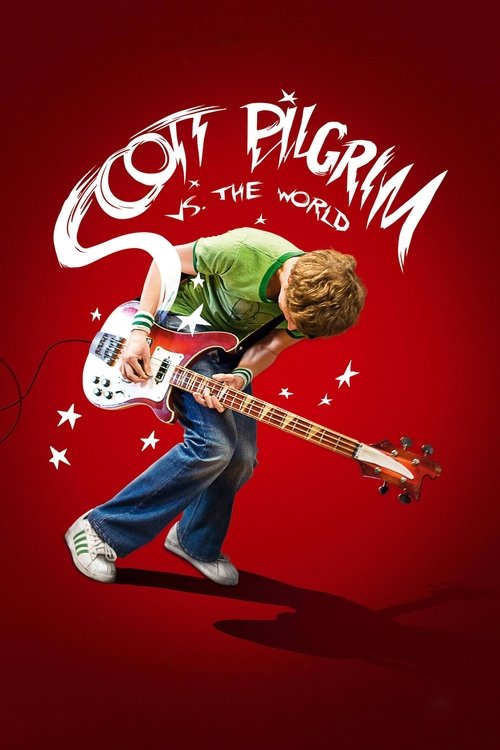
Routh takes the hit. This is an actor who has genuinely charmed audiences twice, as the deadpan straight man getting punched through walls in Scott Pilgrim vs. the World and as the cosmic cornball learning to play with others on Legends of Tomorrow, and both times the charm came from the same place: total commitment. Give him a register and he plays it to the wall. Out of Order! hands him a screenplay that does not know what register it is in, and you can feel him carrying that misalignment for the whole runtime. The disguise work is game. The dual-representation mechanics are worked through honestly. But the script behind the wig and the script in front of it are written in one flat key, so the central gag, Brandon Routh playing two versions of the same man inside one courtroom, never reads as two versions. It reads as one sincere actor trying to disguise a sincerity the material cannot absorb.
The supporting cast splits into two different movies. Sandra Bernhard turns up as a judge whose recurring “order in the court!” hands the film its title, the exclamation point being her gavel, while Luis Guzman bellows from the gallery as the chaotic defendant she keeps trying to silence. Those two are playing the broad farce the movie believes it is. Almost nobody else is, so they land like imports from a wilder picture Jacobson could not talk the rest of the cast into.
Then there is Krysta Rodriguez. As Sue, an associate at Shields’s firm, she is the one ensemble member who read this screenplay as a farce and committed to the music anyway. Watch her enter a scene: she leans into the frame two beats ahead of everyone else, reacting to the joke before her partner finishes setting it up, playing through the dead dialogue instead of around it. She is a Broadway veteran, a lead in First Date, a run on Smash, and her timing is tuned for exactly the screwball this movie keeps gesturing at. Every scene she has is a generous, technically sharp rescue attempt, and every rescue accidentally shows you the picture this could have been if the whole cast had been cued off her rhythm.
I owe the film its best case, because half of me wanted to write it. It goes like this: Out of Order! is a big-swing, deep-bench, old-school studio farce of a kind nobody finances anymore; Shields is having visible fun; Huntington is doing his best deadpan since the Olsen days; the Routh-Huntington chemistry is real, and the storefront scenes prove it; and a festival Saturday night could do far worse than this cast. Every clause of that is true. I felt the pull of it in the storefront scenes myself. But charm is casting and comedy is writing, and a farce that runs on dialogue cannot coast on good people saying dead lines with conviction. Jacobson, co-writing with Megan Freels Johnston, clearly loves the tradition: the outlandish plot mechanics, the stacked ensemble, the premise built on charm. Loving the tradition is not the same as hearing it.
And the ear is not even the real loss. The real loss is the reunion the film never notices it has. Two earnest men at a two-desk practice, running the same patter they built under Bryan Singer, minus the cape and the crossroads. In the right screenplay that friendship is the whole picture. In this one it is the thing you catch in the cracks. Out of Order! arrives in Dallas with a likable lead, a game ensemble, a Broadway-trained scene-stealer, and a premise that wants to work. What it does not have is a second draft.
Lunara Film Debrief
- Score:★★½
- Year:2025
- Where to Watch:FestivalFestival [USA Film Festival, Dallas]Availabilitywider distribution TBD

Theme Echo
What is this film really about — and who else has said it?
Mrs. Doubtfire (1993)
The dual-identity farce with the ingredient this one is missing: a disguise that costs the wearer something real. The wig works there because the lie is love, not billing hours, and the comparison shows exactly what Slater's masquerade never puts at stake.

Counter Program
What is the strongest argument against it?
My Cousin Vinny (1992)
A courtroom comedy built entirely on ear, where every laugh comes from how specific people actually talk under pressure. That is the precise muscle this screenplay lacks, and ninety seconds of Vinny cross-examining a witness teaches the lesson better than any note could.
Career Context
Where does this sit in the artist's story?
Scott Pilgrim vs. the World (2010)
Proof of concept for Routh: hand this actor a script that knows its own register and his total commitment becomes the joke's delivery system instead of its cushion.
More Lunara Film Criticism
Further Reading
 ★★★½
Lunara Film Review
Den of Thieves 2: Pantera — Burn the Blueprints
The first one wanted to be Heat; this one would rather be drunk, and it turns out drunk is the more honest condition.
Updated September 23, 2026
 ★★½
Lunara Film Review
The Gorge — The Distance Was the Movie
Scott Derrickson's two-hander has one of the best premises of the year and the saddest relationship to it -- a film that treats the very...
Updated September 23, 2026
 ★★★
Lunara Film Review
The Monkey — Laughing at the Funeral
Osgood Perkins follows the dread of Longlegs with something that looks like its opposite -- a gleeful splatter comedy about a cursed toy...
Updated September 23, 2026
 ★★★★
Lunara Film Review
Eephus — The Pitch Is the Form
Carson Lund's debut spends one long afternoon watching a meaningless recreational baseball game on a field that is about to be demolished...
Updated September 23, 2026
 ★★★★
Lunara Film Review
In the Lost Lands — Nobody Is Doing It Like This
Paul W.S. Anderson's dark-fantasy Western is being dismissed this week as cheap-looking digital slop. It is not slop. It is a deliberately...
Updated September 23, 2026