
Lunara Review
Triangle of Sadness — Tip the Room, Watch Power Slide
Ostlund's Palme d'Or winner is less a satire than a physics experiment: tilt the deck and see where authority rolls.

Ostlund’s Palme d’Or winner is less a satire than a physics experiment: tilt the deck and see where authority rolls.
The best scene in Triangle of Sadness happens before anyone boards a yacht, in a restaurant where the bill has just arrived and is not being picked up. Carl, a male model on the downslope of his earning years, watches his girlfriend Yaya, a model-influencer on the upslope of hers, perform not seeing the check. What follows is twenty minutes of the most excruciating comedy Ruben Ostlund has ever engineered, an argument that migrates from the table to the taxi to the hotel elevator, in which two beautiful people are forced to say out loud what their relationship runs on. Harris Dickinson plays Carl’s grievance with the squirming precision of a man who knows that citing fairness will read as weakness, and cannot stop citing it anyway. Nobody yells. The elevator doors keep trying to close on the conversation, and Ostlund keeps holding the shot, because his entire method lives in that hold: put a social contract under load, and do not cut away while it creaks.
The yacht section scales the experiment up. A luxury cruise assembles the winners of the global economy, a Russian fertilizer oligarch who introduces himself as a king of, well, exactly what you would guess, a sweet elderly British couple whose fortune turns out to come from hand grenades, the models traveling free in exchange for content, and a crew briefed to answer every request with a yes. Ostlund’s staging is patient and merciless. A guest insists, in a spasm of egalitarian whimsy, that the entire crew take a swim, and the whim cascades through the ship’s hierarchy like a tax, paid at the bottom. Then comes the captain’s dinner, scheduled by a drunk captain into the teeth of a storm, and the film delivers the sequence it will be remembered for: haute cuisine served on a pitching sea, seasickness ripening into a full biological rout, Fredrik Wenzel’s camera tilting with the horizon while the dining room’s flawless lighting keeps advertising luxury through the vomiting. The gross-out is real, but watch what the scene is actually documenting. The staff keep serving. The system keeps performing itself right up until the plumbing revolts along with everything else, and Woody Harrelson’s Marxist captain trades quotations with the capitalist oligarch over the intercom while both are too drunk to steer. Ideology as karaoke, sung from the bridge of a sinking economy.
Then the film pulls its cleanest structural move. Shipwrecked on an island, the survivors discover that the entire value system went down with the boat. Money is paper. Rolexes are paper. The only convertible currency is competence, and the only competent person is Abigail, the ship’s toilet manager, who can catch fish and make fire. Dolly de Leon gives the performance of the film, and its true subject, in the way Abigail conducts her coup: no speeches, just a quiet renegotiation of who eats first and who sleeps in the lifeboat, payment extracted in obedience and, from Carl, in nightly visits. The point lands harder than the vomiting ever did. Hierarchy did not dissolve in the wreck; it re-formed in an afternoon around whoever held the fish. Tyranny, the film argues, is not a character flaw of the rich. It is a property of the position, and Abigail occupies the position exactly the way its previous owners did, which is to say instantly and without shame.
The honest limit is that Ostlund’s targets arrive pre-softened. An arms-dealing granny and an Instagram couple cannot really be hit any harder than their own introductions hit them, and the film’s satire is sharpest precisely where the target might be us, in that opening argument about the bill, where the stakes are small and the recognition is total, and bluntest where the targets are billionaires no viewer identifies with. He also underlines: the intercom ideology duel is perfect at two minutes and continues for five, and a title card structure keeps announcing chapters the film did not need named. Fair is fair, the man knows he is blunt; bluntness is the declared instrument. But Force Majeure proved he can cut deeper when the subject sits closer to home, and the middle chapter of this film occasionally mistakes splatter for penetration.
What redeems every excess is the ending, which is not blunt at all. Abigail and Yaya hike to the island’s far side and find evidence that paradise may be a resort, that the whole shipwrecked order could collapse back into the old one with a single elevator ride. Ostlund cuts between Yaya’s oblivious gratitude and Abigail behind her, holding a rock, weighing the future. The film ends on the weighing, on Carl running through the jungle toward a decision already out of his hands, and the cut to black is the most honest sentence in the picture: power knows exactly what it has, and exactly what it stands to lose, and the rock is always closer than the resort.
LUNARA DEBRIEF
- Score: 4 / 5
- Year: 2022
- Where to Watch: Streaming (Hulu) | VOD (major platforms) | Criterion 4K UHD
- Theme Echo: The Exterminating Angel (1962) tt0056732. Bunuel trapped the elite in a drawing room they were mysteriously unable to leave and watched civilization rot in place; Ostlund needs a storm and an island to reach the same diagnosis. The surrealist got there without the vomit, which is either a criticism or a compliment, and I have never decided which.
- Counter-Program: Titanic (1997) tt0120338. The shipwreck as ennobling romance: class lines drawn so love can cross them beautifully. Ostlund’s wreck ennobles no one and his classes do not cross, they invert, which makes Cameron’s film the perfect control group for this experiment.
- Career Context: Force Majeure (2014) tt2121382. Ostlund’s sharpest instrument, one avalanche and one husband’s flinch, proving his method works best when the load-bearing social contract is a marriage rather than an economy. The man who ran from the table is Carl’s true ancestor.
LUNARA DEBRIEF
- Score:★★★★
- Oscar Ledger3 nominations • 0 wins
- Year:2022
- Where to Watch:
Pair It With
Three films in conversation with this one.

Theme Echo
The Exterminating Angel (1962)
Bunuel trapped the elite in a drawing room they were mysteriously unable to leave and watched civilization rot in place; Ostlund needs a storm and an island to reach the same diagnosis. The surrealist got there without the vomit, which is either a criticism or a compliment, and I have never decided which.

Counter-Program
Titanic (1997)
The shipwreck as ennobling romance: class lines drawn so love can cross them beautifully. Ostlund's wreck ennobles no one and his classes do not cross, they invert, which makes Cameron's film the perfect control group for this experiment.
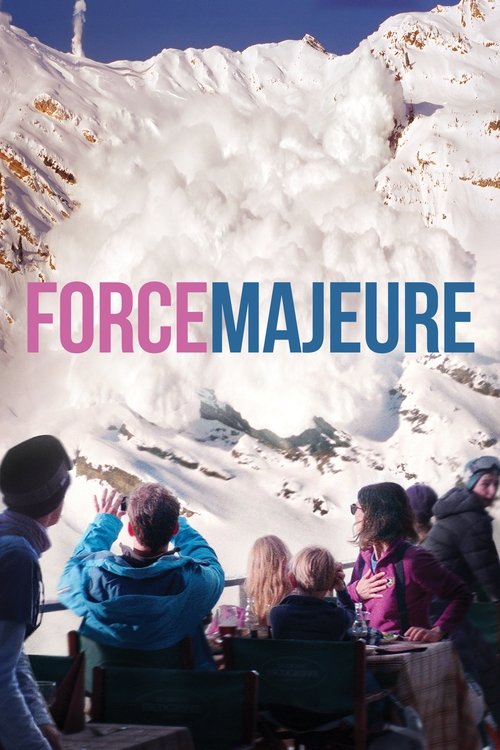
Career Context
Force Majeure (2014)
Ostlund's sharpest instrument, one avalanche and one husband's flinch, proving his method works best when the load-bearing social contract is a marriage rather than an economy. The man who ran from the table is Carl's true ancestor.
Further Reading
More Lunara Criticism
 ★★★★★
★★★★★
Lunara Review
Decision to Leave — Surveillance Is the Love Language
Park Chan-wook's detective romance understands the terrible secret of both professions: to investigate someone and to love someone are the same activity.
Updated July 25, 2026
 ★★★½
★★★½
Lunara Review
Black Panther: Wakanda Forever — Stronger as Eulogy Than Entertainment
The first franchise film that had to bury its star before it was allowed to tell a story.
Updated July 25, 2026
 ★★★★★
★★★★★
Lunara Review
Babylon — The Movies Were Never Respectable
Three hours of vomit, jazz, and dying stars, all of it in defense of one heretical idea: the sacred thing was built by the vulgar people.
Updated July 25, 2026
 ★★★★½
★★★★½
Lunara Review
All Quiet on the Western Front — The Uniform Outlives the Boy
Edward Berger's war film opens with laundry, and the laundry is the most frightening thing in it.
Updated July 25, 2026
 ★★
★★
Lunara Review
Thor: Love and Thunder — A Tone Is Not a Formula
A father buries his daughter, a god laughs in his face, and then a goat screams: the sequel that could not pick a movie and lost...
Updated July 25, 2026