
Lunara Review
Burn After Reading — Nobody Learns Anything
The Coens' spy comedy has no spy and no secret; eighteen years on, that is the scariest thing in it.
The Coens’ spy comedy has no spy and no secret; eighteen years on, that is the scariest thing in it.
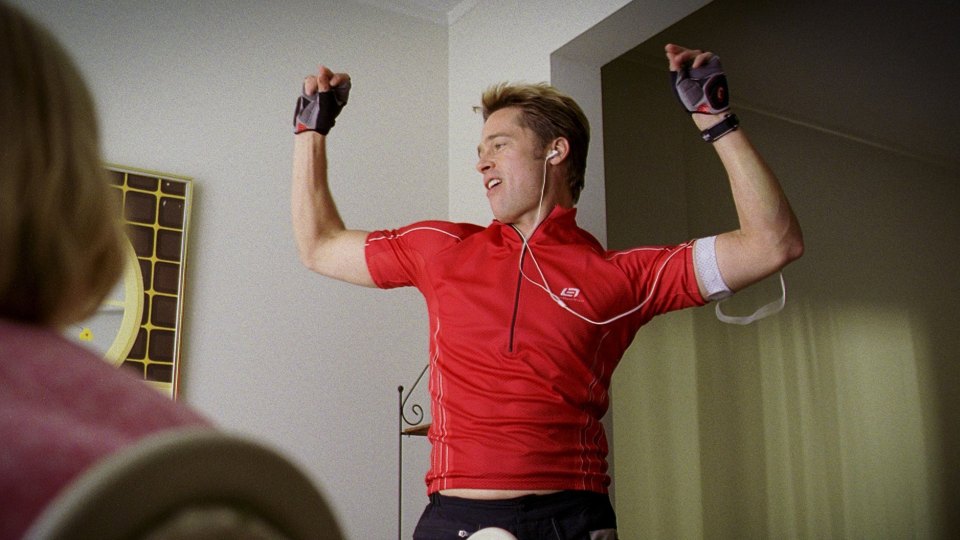
The funniest phone call of the century is a blackmail attempt by a man who has no idea what he is holding. Chad Feldheimer, personal trainer, sits in a parked car with his notes on his lap and delivers the line he has clearly rehearsed in a mirror: Osborne Cox? I thought you might be worried. About the security. Of your shit. Brad Pitt plays it as pure sunshine, a golden retriever who has seen some movies and knows how this is supposed to go. On the other end is a Princeton man who wrote actual intelligence assessments for the Central Intelligence Agency, and the joke detonating in slow motion across the rest of the film is that he cannot process what he is hearing, because he assumes the voice must have a plan, an agency, a design behind it. There is no design. There is a gym employee, a found CD, and the momentum of American self-invention. Burn After Reading is two hours of serious people searching for the intelligence behind events, in a country that has stopped producing any.
The chain reaction is a Rube Goldberg drawing of the 2000s. Osborne Cox gets demoted off the Balkans desk for drinking, materializes his wounded ego into a memoir he pronounces like a French delicacy, mem-wahs. His wife Katie, a pediatrician with the bedside manner of an ice pick, copies his files for her divorce lawyer, and the disc goes astray at a gym called Hardbodies, where it lands in the hands of Chad and of Linda Litzke, a woman who has audited her own body like a hostile accountant and priced her happiness at exactly four cosmetic procedures her insurance will not cover. The disc contains nothing: rough memoir pages and household finance spreadsheets. It does not matter. Linda needs it to be valuable, so it is, and when Osborne declines to pay, she walks the raw intelligence into the Russian embassy with the breezy confidence of a woman returning a blender. Orbiting all of it is Harry Pfarrer, twenty years of federal protection work without once discharging his weapon, jogging off his paranoia, building something unspeakable in his basement, sleeping with Katie and with Linda and with anyone the internet supplies. Every character is optimizing something, a body, a memoir, a marriage, a marathon time, and not one of them can read a single document that crosses their path.
That is the film’s discovery, and time has only notarized it: the great American institutions of the era, the security state and the self-improvement industry, are the same religion practiced at different altars, total collection, zero comprehension. The Coens build the joke into the form itself. Carter Burwell supplies genuine war drums, dread percussion worthy of a Bourne picture, over shots of people power-walking; the camera does clenched surveillance push-ins on gym lockers and juice bars; the satellite bookends drop us from orbit into Langley at the start and reel us back out at the end, the state’s own point of view, all resolution and no understanding, an eye that can read a license plate from space and cannot read a motive across a desk. The film is a thriller with the espionage removed, and the horrifying punchline is that the form still works. Our genre grammar will make anything feel purposeful. That is how a country talks itself into a decade.
The performances are a bestiary of American confidence. Malkovich, all Princeton ring and bathrobe, turns fury into an aria, marooned on his father’s boat bellowing about the league of morons that has replaced his country, never once suspecting he holds a membership card. Swinton plays Katie as one long paper cut. McDormand makes Linda the era’s most frightening optimist, a woman for whom every corpse is an obstacle on the road to reinvention, incapable of registering catastrophe as anything but scheduling. Richard Jenkins, as the Hardbodies manager quietly in love with her, a gentle man with a pastoral streak who left a more contemplative life to shepherd treadmills, is the film’s one working soul, which in this universe is a death sentence with a delay on it. And Pitt gives the comic performance of his career as a man so innocent of subtext that bullets seem like an overreaction to him even as they arrive. His exit is the film’s hinge: hiding in a closet on a freelance snoop errand, he is discovered, and his grin is still assembling its explanation when Harry’s twenty-year virgin sidearm goes off. The Coens execute the funniest character in the picture mid-smile, on purpose. The farce keeps going. The floor under it is gone.
Presiding over the wreckage, in three scenes that now read as the film’s whole point, is J.K. Simmons behind a CIA desk, receiving reports of events he cannot make cohere. His instruction is the era’s foreign policy in miniature: keep an eye on everyone, see what they do, report back when it makes sense. It never makes sense. Bodies accumulate, a man ends up in a coma, another flees to Venezuela, and the agency’s final act is to pay for Linda’s surgeries because it is the cheapest way to make the file stop existing, American self-care underwritten by the security budget. Then the exchange the film has been saving, the one that has replaced entire think-tank shelves in my estimation of the decade: what did we learn? I don’t know, sir. I don’t know either. I guess we learned not to do it again. Released into the last months before the economy followed the plot’s example, the film was widely filed as a doodle between the Coens’ serious pictures. The following eighteen years, the leaked collection programs, the unread briefings, the Russians back in the punchline, the perfect national fluency in consequence avoidance, have promoted it. No Country for Old Men gave chaos a face and a haircut. Burn After Reading says the scarier true thing: there is no face. There is only paperwork, and it is not being read.
The temperature is the problem. The steelman against this film says the Coens are boys burning ants: it murders its two innocents, Chad and Ted, and feels nothing; Katie never becomes more than acid; the middle stretch coasts on repetition of Harry’s tics. Partial guilty plea: the cruelty is real, the warmth deficit is real, and Jenkins’ wounded decency is the receipt the film hands you on the way out. But the heartlessness has a position. The movie is written from the satellite’s altitude, the state’s own moral distance, where feeling is the one data type the format cannot record, and the absence is the finding. You are not being invited to laugh with the void; you are being shown the view from it. That a comedy this merciless closes on the decade’s most honest epitaph, nobody learned anything and the checks cleared, is exactly why it has aged from lark into landmark. Burn after reading, and report back when it makes sense.
LUNARA DEBRIEF
- Score: 5 / 5
- Year: 2008
- Where to Watch: VOD [all major platforms] | Universal disc
- Theme Echo: Dr. Strangelove (1964) tt0057012. Institutional idiocy at its ceiling: Kubrick’s systems end the world by working exactly as designed; the Coens shrink the same physics to a gym bag and a divorce. The distance between doomsday and a hatchet on a sidewalk is just budget.
- Counter-Program: Tinker Tailor Soldier Spy (2011) tt1340800. Espionage where reading works: patient men in beige rooms extracting truth from files through grief and craft. It restores every competence Burn deletes, and the restoration proves the deletion was the point. The tradecraft was fine; the country changed.
- Career Context: Fargo (1996) tt0116282. The same collapsing-scheme physics with one difference: Marge, a moral center who can look at the wreckage and name the sadness. Twelve years later the Coens rerun the experiment with the control group removed, and promote the desk that shrugs.
LUNARA DEBRIEF
- Score:★★★★★
- Year:2008
- Where to Watch:DigitalFind Digital OptionsAvailabilityUniversal disc
Pair It With
Three films in conversation with this one.

Theme Echo
Dr. Strangelove (1964)
Institutional idiocy at its ceiling: Kubrick's systems end the world by working exactly as designed; the Coens shrink the same physics to a gym bag and a divorce. The distance between doomsday and a hatchet on a sidewalk is just budget.

Counter-Program
Tinker Tailor Soldier Spy (2011)
Espionage where reading works: patient men in beige rooms extracting truth from files through grief and craft. It restores every competence Burn deletes, and the restoration proves the deletion was the point. The tradecraft was fine; the country changed.

Career Context
Fargo (1996)
The same collapsing-scheme physics with one difference: Marge, a moral center who can look at the wreckage and name the sadness. Twelve years later the Coens rerun the experiment with the control group removed, and promote the desk that shrugs.
Further Reading
More Lunara Criticism
 ★★★★★
★★★★★
Lunara Review
Fargo — Two Uses for Nice
The accent everybody imitates is doing two different jobs: for Jerry it is camouflage, for Marge it is a method.
Updated July 25, 2026
 ★★★
★★★
Lunara Review
The Ladykillers — The Soundtrack Believes, the Movie Grins
The Coens' Southern remake has a churchful of soul on the soundtrack and a cartoon where its menace should be.
Updated July 25, 2026
 ★★★★★
★★★★★
Lunara Review
Barton Fink — The Common Man Knocks
The Coens' Hollywood nightmare is not about writer's block; it is about a writer who never once listens.
Updated July 25, 2026
 ★★★★★
★★★★★
Lunara Review
No Country for Old Men — The Thriller That Stops Answering
The Coens' McCarthy adaptation keeps subtracting everything a chase picture owes you, and every subtraction is the meaning.
Updated July 25, 2026
 ★★★★★
★★★★★
Lunara Review
Miller’s Crossing — Love, Disguised as Treachery
The Coens' gangster picture is about a man who can only protect what he loves by betraying it, and a hat he will not chase.
Updated July 25, 2026